

How to sell a timeshare: In most cases, you can’t sell it for a profit—and many times, you can’t sell it at all. That’s because timeshares are not designed to appreciate, and state laws like Florida Statute Chapter 721 explicitly prohibit selling them as investments or promising resale value.
Table of Contents
- Why Selling a Timeshare Feels Logical
- The Reality of Timeshare Value
- Why the Resale Market Fails
- Florida Law: Why Your Timeshare Was Never Meant to Be Sold For a Profit
- Oral Promises vs Written Contracts
- Resale, Rental, and Transfer Restrictions
- Legacy Timeshare Resorts vs Modern Vacation Clubs
- The Viking Ship Era and Its Fallout
- The Truth About a Timeshare Resale Company
- Why Listing Is Not Selling
- Are There Best Timeshare Resale Companies?
- Case Study: What We See Every Day at VOC
- The Real Question: Can I Sell My Timeshare?
- What Actually Works Instead of Resale
- Key Takeaways
Why Do Owners First Try to Sell a Timeshare?
It makes sense.
You paid thousands for your timeshare.
You assume it works like traditional real estate.
You expect to recover at least part of your investment.
That thinking is logical—but it’s based on a flawed premise.
Back in the 1980s, timeshares were often positioned alongside whole ownership real estate. Many buyers believed their interest would increase in value over time.
But here’s the disconnect:
- Real estate appreciates
- Timeshares and Vacation Clubs depreciate
The land may increase in value.
Your fractional ownership does not.
Why?
Because your ownership comes with a lifetime financial obligation and strict usage restrictions.
What Is the Real Timeshare Value?
Timeshare value: In most cases, near zero on the resale market.
Florida law reinforces this reality. It requires disclosures stating that timeshares should be purchased for vacation use—not as an appreciating investment.
This means:
- No guaranteed resale value
- No expectation of appreciation
- No promise of rental income
In fact, the statute explicitly prohibits:
- Predicting value increases
- Assigning a specific resale value
- Suggesting reliable resale opportunities
So why does the value collapse?
Because buyers are not purchasing an asset.
They are inheriting a liability.
Why Does the Resale Market Fail?
Let’s break it down simply.
Supply vs Demand Imbalance
- Hundreds of thousands of timeshares are listed online
- Very few buyers exist
Ongoing Costs Kill Demand
Buyers see:
- Annual maintenance fees
- Special assessments
- Booking restrictions
Then they compare it to:
- Airbnb
- Expedia
- Hotels with no long-term obligation
The result?
No incentive to buy.
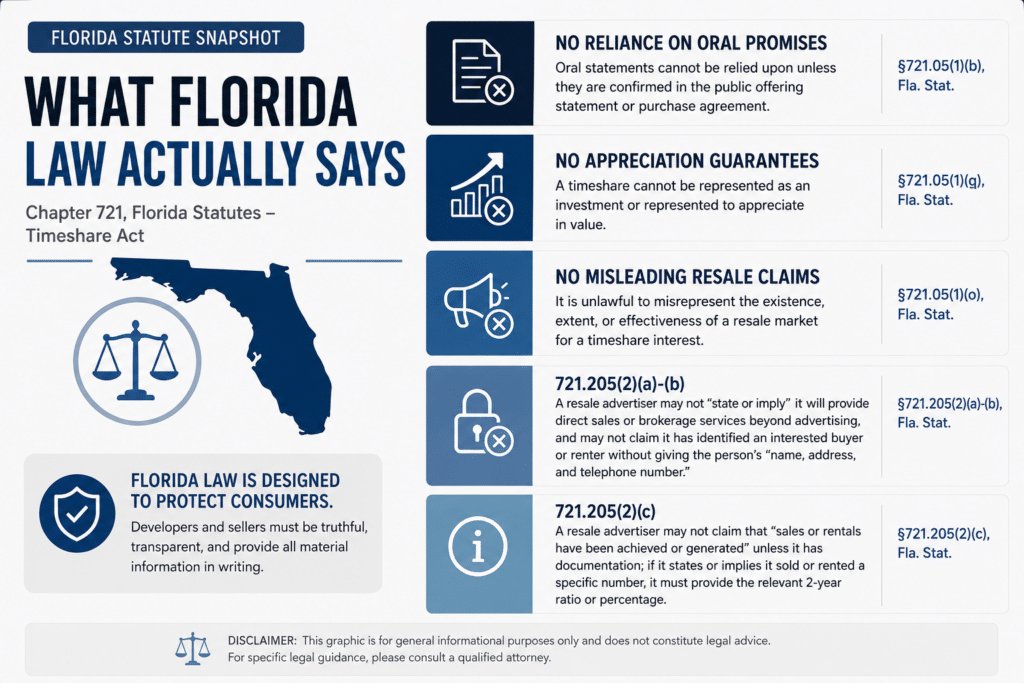
Florida Law Explains the Problem Clearly
Florida Statute Chapter 721: VACATION AND TIMESHARE PLANS is blunt.
It requires developers to disclose:
- You should not rely on verbal statements
- The product is not an investment
- Resale may be restricted or controlled
Anti-Investment Disclaimer
Section 721.07(5)(p)2 states:
- A timeshare should be purchased for vacation use
- Not for appreciation or resale expectations
No Misleading Value Claims
The law prohibits:
- Claims of value growth
- Predictions of appreciation
- Misleading resale opportunities
Developer Responsibility
Developers are responsible for their sales agents’ claims.
They cannot shift blame for misleading financial statements.
Why Oral Promises Don’t Matter
Can I sell my timeshare?
Answer: Only if a buyer is willing to take on the financial burden—and most are not.
Florida law is clear:
- You cannot rely on oral representations
- Only the written contract matters
This is where many owners feel misled.
They were told:
- “You can always sell it”
- “It will increase in value”
- “You can rent it out easily”
But none of that appears in the contract.
Therefore, it may not count.
Hidden Restrictions That Kill Resale
Should you hire a timeshare resale company?
Answer: Possibly, but restrictions often make resale difficult even with an experienced company, or if your timeshare holds no value.
Florida law requires disclosure of:
- Transfer restrictions
- Leasing limitations
- Right of first refusal by the developer
These restrictions:
- Limit who you can sell to
- Allow developers to block sales
- Reduce buyer interest even further
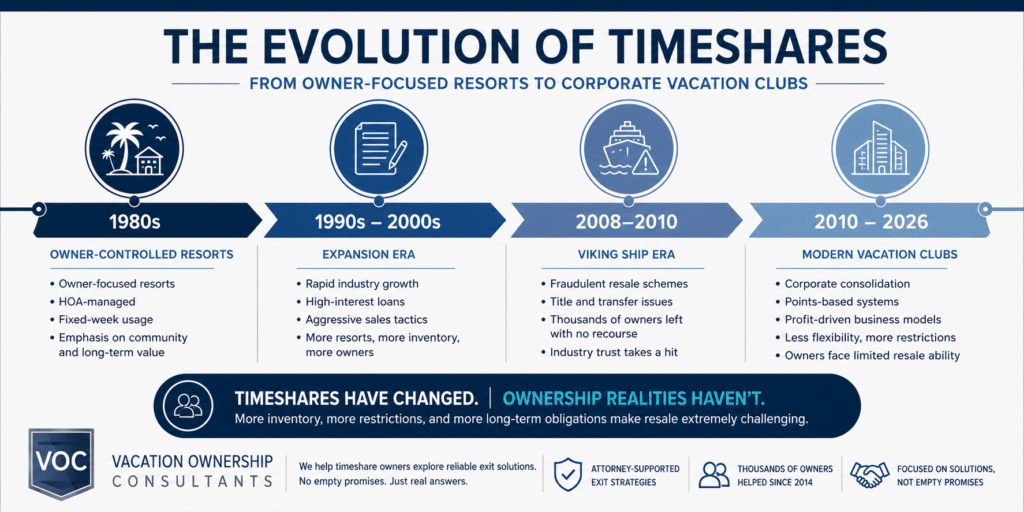
From Owner-Controlled Resorts to Corporate Systems
The 1980s Model
- Owner-managed associations
- Board of directors were owners
- Shared interest in maintaining value
Today’s Model
- Corporate-controlled vacation clubs
- Publicly traded companies
- Profit-driven decision making
Owners now:
- Have limited control
- Face increasing costs
- Receive fewer benefits
This shift changed everything.
Why Legacy Resorts Are Hard to Sell
Older resorts face major challenges:
- Aging ownership base
- High delinquency rates
- Limited maintenance budgets
The result:
- Poor property condition
- Declining desirability
- No resale demand
At VOC, we’ve reviewed cases where owners tried to sell for years—with no offers.
Points Systems Impact on Resale
Modern vacation clubs:
- Convert ownership into points
- Centralize control with corporations
This creates:
- More restrictions
- Less transparency
- Increased costs
And importantly:
- A limited resale market
The Viking Ship Era (And Why It Still Matters)
After the 2008 financial crisis, a new problem emerged.
Companies began offering “transfers” into shell corporations.
These were known as “Viking ship” transfers.
Here’s what happened:
- Owners paid large fees
- Timeshares were transferred to fake entities
- Maintenance fees went unpaid
- Titles became clouded
In many cases:
- The original owner remained liable
This era forced developers to tighten transfer rules—making resale even harder today.
The Truth About a Timeshare Resale Company
Are there legitimate options?
Yes—but most are misunderstood.
A timeshare resale company often:
- Does not sell your timeshare
- Provides advertising services only
- Charges upfront fees
Florida law regulates this heavily.
It prohibits resale advertisers from:
- Pretending to be brokers
- Claiming buyers exist without proof
- Assigning resale value
- Making unsupported success claims
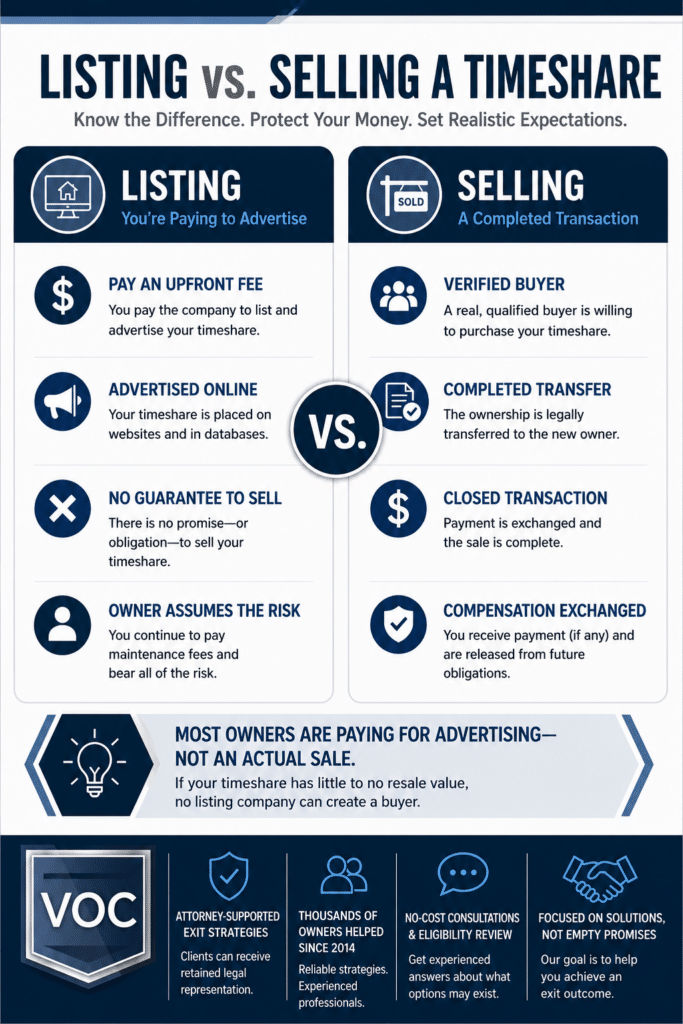
Why Listing Is Not Selling
This is the biggest misconception.
Listing = Advertising
Selling = Completed Transaction
Most owners pay:
- $500 to $5,000 upfront
For:
- A listing on a website
With:
- No guarantee of sale
Meanwhile:
- The company gets paid
- The owner gets nothing
Do Best Timeshare Resale Companies Exist?
What are the best timeshare resale companies?
Answer: The “best” ones are simply transparent about the reality—most timeshares will not sell. Many resale companies only provide advertising services with no guarantee of a sale.
For many owners, the better path is not resale at all. It may be better to speak with an experienced timeshare exit company instead. Vacation Ownership Consultants offers no-cost consultations to help owners understand what realistic options may exist to exit their timeshare obligation.
A legitimate timeshare resale company should:
- Not promise resale success
- Not assign a value
- Not charge excessive upfront fees
Florida law requires:
- Documented success rates
- Verified buyer claims
- Clear disclaimers
If those are missing, proceed cautiously.
Why the Economics Don’t Work
| Asset Type | Average Sale Price | Commission Potential |
|---|---|---|
| Home | $450,000 | $13,500 at 3% |
| Timeshare | $0 – $3,000 | Minimal to none |
Real estate agents earn commissions.
Most timeshare resellers don’t.
So they shift to:
- Upfront advertising fees
That’s the business model.
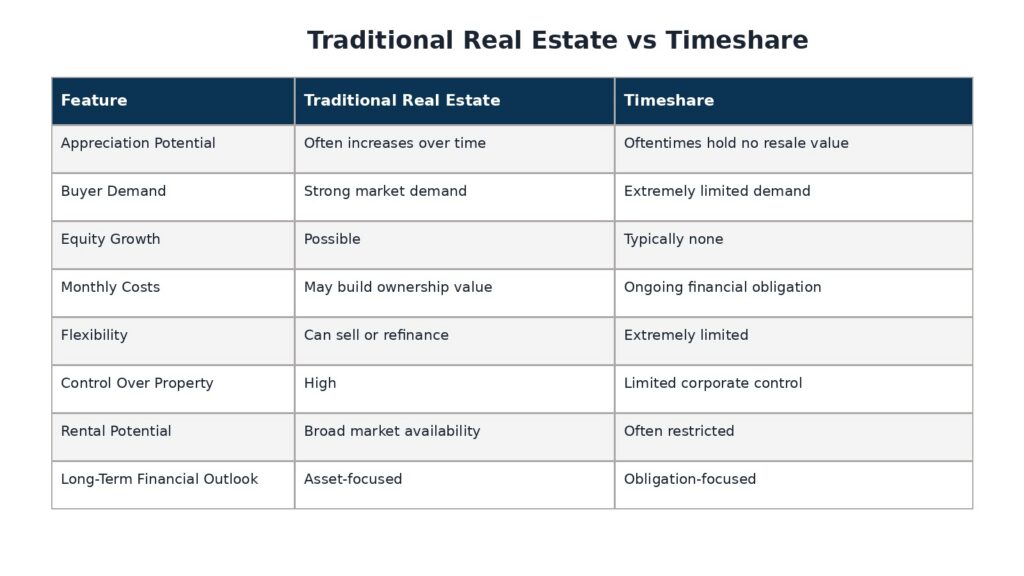
Traditional Real Estate vs Timeshare
VOC Case Insight (Real-World Example)
At Vacation Ownership Consultants, we regularly see:
- Owners listing for 3–5 years before hiring us
- Received no serious offers
- Thousands spent on listing services
One client came to us after:
- Paying $3,000 on average to list
- Renewing ads for two years
- Receiving zero buyer inquiries
Their question was simple:
“Why won’t it sell?”
The answer:
There was no market.
What Happens in a Resort Takeover?
In some cases, resorts undergo restructuring.
When a controlling interest takes over:
- Owners lose influence
- Decisions favor investors
- Exit options become limited
Even in liquidation scenarios:
- Owners rarely receive proceeds
The Bigger Picture: Why You Can’t Sell
Let’s summarize the core reasons:
1. No Investment Value
Legally defined as a vacation product
2. Ongoing Financial Burden
Maintenance fees never stop
3. Oversupply
Too many sellers, not enough buyers
4. Corporate Control
Limited owner rights
5. Legal Restrictions
Transfer and resale limitations
Still Asking, Can I Sell My Timeshare?
Answer: In rare cases, yes—but most owners will not find a buyer willing to assume the obligation.
That’s the reality.
Owners should strongly consider speaking with an experienced timeshare exit company like Vacation Ownership Consultants. VOC offers no-cost consultations to help owners understand what reliable, structured options may exist to exit their timeshare obligation.
What Actually Works Instead
Instead of resale, owners often explore:
- Developer surrender programs
- Negotiated exits
- Legal contract termination
At VOC, we focus on:
- Attorney-supported strategies
- Individualized case reviews
- Structured exit solutions
Because the goal is not to sell.
The goal is to end the obligation.
Key Takeaways
- How to sell a timeshare is the wrong question for most owners
- Timeshares are not investments
- Resale value is typically negligible
- Listing companies profit even if you don’t sell
- Florida law protects consumers—but also reveals the truth
If you’re asking how to sell your timeshare, you’re already feeling the weight of ownership.
The better question is:
What is the most reliable way to exit it?
That’s where strategy—not resale—comes into play.
If you’re trying to understand what realistic options exist, it may be time to shift away from the resale mindset entirely. Instead, consider speaking with an experienced timeshare exit company that focuses on contract resolution—not listing or advertising.
Vacation Ownership Consultants offers a no-cost consultation and eligibility review to help you understand what reliable, structured options may be available based on your specific ownership, resort, and financial situation. Rather than attempting to sell in a market with little demand, the focus is on identifying a legitimate path to exit the obligation altogether.
About the Author
This content was prepared with insight from Vacation Ownership Consultants (VOC), an attorney-supported timeshare exit firm established in 2014 and headquartered in Scottsdale, Arizona. With over a decade of experience reviewing timeshare contracts, owner experiences, and industry developments, VOC specializes in structured contract termination strategies tailored to each owner’s situation.
VOC has assisted thousands of timeshare owners nationwide and is recognized for its transparent, flat-fee model and individualized approach. The company has been featured on ABC15 Arizona’s Sonoran Living as well as the Better Business Bureau’s Joe Knows Better and maintains strong client satisfaction across major review platforms. Guidance in this article reflects ongoing analysis of industry practices, documented case outcomes, and industry frameworks.
The information provided on this platform is for general informational purposes only. It does not constitute legal advice, nor does it establish an attorney-client relationship. You should not act or rely upon any information contained in this content without first seeking the advice of a licensed professional in your specific jurisdiction.
Common Questions for How to Sell a Timeshare
1. How do I know if my timeshare has resale value?
Most timeshares have little to no resale value due to ongoing maintenance fees, oversupply, and limited buyer demand. If you cannot find legitimate buyers, an experienced timeshare exit company or attorney-supported exit service may help you explore more realistic options to end the obligation. VOC offers a no-cost consultations for timeshare owners.
2. Why is it so hard to sell a timeshare?
Timeshares are difficult to sell because most buyers do not want long-term financial obligations, annual fees, or usage restrictions. When resale is not realistic, many owners turn to experienced timeshare exit companies for structured exit strategies. Contact Vacation Ownership Consultants for a free assessment on reliable options.
3. Can a timeshare resale company guarantee a sale?
No legitimate company can guarantee a sale if there is no actual market demand. Many resale companies only provide advertising services, which is why owners often seek attorney-supported exit solutions instead. Vacation Ownership Consultants has over a decade of experience providing tried-and-true timeshare exit solutions.
4. What should I do if my timeshare will not sell?
If your timeshare is not attracting buyers, continuing to pay listing fees may only increase your losses. An experienced timeshare exit company can help evaluate whether surrender, negotiation, or legal exit pathways may be available. Start by completing an eligibility form with Vacation Ownership Consultants for a no-cost consultation.
5. Are timeshares considered investments?
No. Florida law specifically states that timeshares should not be purchased as appreciating investments or with expectations of resale profit. Owners who discover this reality often seek reliable exit strategies to eliminate the long-term obligation. If you’re stuck in an unwanted timeshare, contact VOC at 800-614-5288 for reliable exit strategies.
6. What is the difference between listing and selling a timeshare?
Listing means paying to advertise the timeshare, while selling means a completed transfer to a verified buyer. Since most timeshare listings never result in sales, many owners eventually explore attorney-supported exit services instead. VOC is a recognized industry leader providing reliable timeshare exit services since 2014.
7. Why do timeshare maintenance fees keep increasing?
Maintenance fees often rise due to resort operating costs, delinquency rates, renovations, and inflation. As costs grow, experienced timeshare exit companies may help owners pursue structured solutions to stop future liability. Complete an eligibility form with Vacation Ownership Consultants for a no-cost consultation.
8. Can I stop paying my timeshare maintenance fees?
Stopping payments without a strategy can create financial, credit and potential legal consequences. Instead, owners should speak with an experienced timeshare exit company or attorney-supported service to understand structured and more reliable options. Vacation Ownership Consultants provides an initial consultation at no cost.
9. Are verbal promises made during timeshare sales presentations legally binding?
In most cases, owners will find this answer to be “no”. Florida law warns buyers not to rely on oral statements outside the written contract and public offering statement. Owners who feel misled often seek legal or attorney-supported exit assistance. Contact Vacation Ownership Consultants for a no-cost consultation and receive a tailored timeshare exit strategy.
10. Why do so many timeshares end up listed online for $1?
Many owners simply want relief from future fees and obligations. When resale value disappears, experienced timeshare exit companies may provide a more practical path forward than trying to sell. VOC is a trusted, industry leading timeshare exit company.
11. What are transfer restrictions in a timeshare contract?
Many resorts restrict resale, rentals, or ownership transfers through their governing documents. These restrictions can make resale extremely difficult, which is why attorney-supported exit strategies may become necessary. Contact Vacation Ownership Consultants for a no-cost consultation on reliable options.
12. Can a timeshare be inherited?
Yes. In many cases, timeshare obligations can pass to heirs or estates. Families concerned about inheritance liability often contact experienced timeshare exit companies to address ownership before it becomes an issue later. Vacation Ownership Consultants has over a decade of experience assisting retirees with timeshare exit solutions.
13. What is a Viking ship transfer?
A Viking ship transfer is a fraudulent transfer scheme where a timeshare is transferred into a shell company with no intent to maintain ownership obligations. Owners should avoid these risky schemes and instead work with reputable, attorney-supported exit providers.
14. When should I contact a timeshare exit company?
If your timeshare will not sell, fees continue rising, or the ownership no longer fits your lifestyle, it may be time to speak with an experienced timeshare exit company. Early guidance can help owners avoid costly resale scams and failed transfer attempts. Vacation Ownership Consultants is a reliable timeshare exit company that has been featured in ABC15 Sonoran Living and the Better Business Bureau’s Joe Knows Better segments.
15. What does an attorney-supported timeshare exit service do?
Attorney-supported services may help owners evaluate surrender programs, negotiate directly with resorts, and pursue structured contract termination strategies. Companies like Vacation Ownership Consultants provide no-cost consultations to help owners understand what realistic exit options may exist.