

Timeshare exit is more difficult in 2026 because the industry is growing, not shrinking. Contracts are designed for long-term retention, resale markets are saturated, and resorts now profit from both owners and public rentals. As a result, timeshare contract termination typically requires a structured approach, which may include internal resort programs, negotiated settlements, or timeshare legal support such as a timeshare cancellation lawyer or a qualified timeshare exit company. The right path can depend on ownership type, owner circumstances, and the resort’s policies.
Table of Contents
- What is a timeshare exit?
- Why is timeshare exit so difficult today?
- Why do owners want to terminate their timeshare contract?
- How does industry growth impact exit options?
- What is right-sizing and resort consolidation?
- Why can’t most owners sell their timeshare?
- What are the main timeshare exit options in 2026?
- Step-by-step: How to pursue timeshare contract termination
- Comparison table: Exit options explained
- Key definitions (simple explanations)
- Case studies
- Key takeaways
- FAQ
What is a Timeshare Exit?
A timeshare exit is the process of ending your legal and financial obligation to a timeshare.
This typically includes:
- Ending maintenance fees
- Resolving any loan or contract
- Receiving a formal release, termination or recovery
Timeshares are designed as long-term obligations with increasing costs that can exceed inflation, making timeshare exit challenging—though experienced timeshare legal professionals or a timeshare exit company can provide a clear path forward.
Why Is Timeshare Exit So Difficult Today?
Timeshare exit is difficult because the industry structure favors retention, not release.
First, contracts are long-term and airtight. Second, resorts generate ongoing revenue from maintenance fees and upgrade opportunities. Third, many exit outcomes are negotiated privately and not publicly documented.
Additionally, internal exit programs often require:
- Financial hardship proof
- Long review timelines
- Continued fee payments during review
As a result, many owners turn to timeshare legal strategies or a timeshare exit company to assist with navigating the process and achieving an exit outcome. To understand why these solutions are often necessary, it’s important to first examine the common reasons owners seek timeshare contract termination in the first place.
Why Do Owners Want to Terminate Their Timeshare Contract?
Owners pursue timeshare exit when the product no longer aligns with their lifestyle, finances, or expectations. As they age or transition to fixed incomes, rising maintenance fees and limited usage often turn the timeshare into a recurring expense rather than a benefit. Additionally, many owners report difficulty securing reservations, ongoing sales pressure, and dissatisfaction stemming from verbal representations that do not match the written agreement. Over time, these factors compound, leading owners to seek a structured timeshare exit supported by informed, and often timeshare legal, strategies.
The most common reasons owners seek timeshare contract termination:
1. Aging and Mobility Changes
- Travel becomes more difficult
- Health issues limit usage
2. Fixed Income and Rising Costs
- The average maintenance fees per interval equivalent reached $1,480 in 2024
- Fees continue rising into 2026
- Owners need to reduce non-essential expenses
3. Limited Availability
- Booking systems are often difficult to use
- Desired dates are often unavailable
4. Sales Misrepresentations
- Verbal sales promises differ from contracts
- Common claims include resale or rental income potential
5. Ongoing Sales Pressure
- Owners face repeated, unwelcome upsell presentations
6. Lack of Use
- Timeshare becomes an unused expense
7. Declining Experience
- Resort quality may decline
- Trading value may decrease
In short, most timeshare exits are driven by a mismatch between expectations and reality. This gap between expectation and reality is not occurring in isolation—it is directly influenced by broader industry trends, which helps explain how continued growth impacts timeshare exit outcomes for owners.
How Does Industry Growth Impact Timeshare Exit?
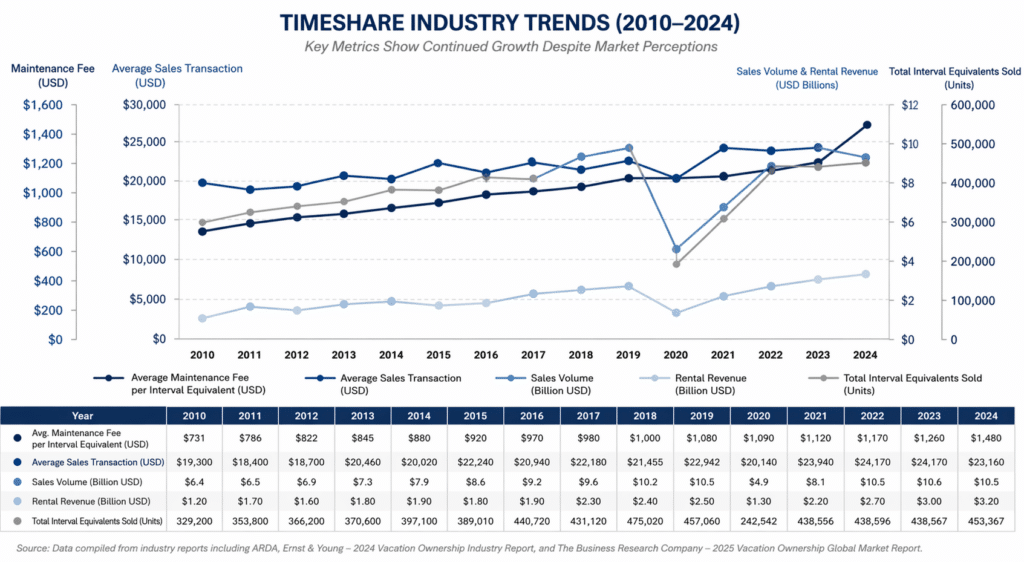
The industry is expanding, making exit options more difficult
Despite public perception, the timeshare industry continues to grow. Industry data shows that sales volume increased from approximately $6.4 billion in 2010 to over $10.5 billion by 2024, while rental revenue nearly tripled during the same period. At the same time, the average maintenance fee rose from $731 to $1,480, reflecting a steady expansion in recurring costs for owners. As illustrated in the chart above, these upward trends across multiple metrics confirm that the industry is not declining—it is evolving and expanding, which directly impacts the complexity of timeshare exit and timeshare contract termination for owners.
Key Data Trends (2010–2024)
| Metric | 2010 | 2024 |
|---|---|---|
| Sales Volume | $6.4B | $10.5B |
| Avg. Maintenance Fee | $731 | $1,480 |
| Rental Revenue | $1.2B | $3.2B |
What does this means for owners?
- More contract upgrades = more long-term obligations
- Resorts rely on recurring revenue and upsell opportunities
- Exit is often not a priority for developers
As the industry grows, the need for structured timeshare exit solutions also increases. In 2020, the National Association of Attorneys General (NAAG) published their concerns on the growing timeshare industry and its impact on consumers:
“Given this volume of sales and the substantial expense of timeshares, any deficiencies in consumer protection in this area will have a massive impact on consumers nationwide. Unfortunately, the current landscape of the timeshare industry has exposed significant inadequacies in protection for those seeking to purchase, lease, or exit their timeshare contracts.”
As the timeshare industry expands, consumer protection gaps have grown alongside it, increasing the need for structured timeshare exit and timeshare contract termination solutions.
This evolving landscape has also led developers to adopt broader operational strategies, such as right-sizing and consolidation, which further reshape ownership structures and directly influence how owners can exit their timeshare obligations.
What is Right-Sizing and Timeshare Consolidation?
Right-sizing is a property-level restructuring strategy
Right-sizing refers to how developers restructure entire resorts or portfolios to improve operational efficiency and long-term profitability. This often involves evaluating underperforming properties, adjusting inventory levels, and realigning ownership structures to better match demand. In practice, it may include reducing excess intervals by converting them to whole ownership sales, or converting a portion of the timeshare project into a hotel for nightly rentals while remaining units continue to operate under the timeshare plan. While these changes are designed to strengthen the developer’s financial position, they can significantly alter an owner’s usage rights, costs, and potential pathways for timeshare contract termination.
What consolidation means in practice
Industry consolidation involves larger developers acquiring legacy resort projects and timeshare entities. Recent, major industry acquisitions include:
- Hilton Grand Vacations (HGV) completed its acquisition of Diamond Resorts International for approximately $1.4 billion in August 2021
- Hilton Grand Vacations (HGV) completed its acquisition of Bluegreen Vacations on January 17, 2024, for approximately $1.5 billion
- Marriott Vacations Worldwide completed the acquisition of Welk Resorts for approximately $430 million in April 2021, rebranding its eight properties in California, Colorado, Missouri, New Mexico, and Cabo San Lucas as Hyatt Residence Club
- Marriott Vacations Worldwide (MVW) acquired Vistana Signature Experiences in 2018 as part of its $4.7 billion acquisition of ILG, Inc., which previously operated the former Starwood timeshare business
- Marriott International purchased Starwood Hotels & Resorts Worldwide in 2016 for roughly $13 billion, which included the Sheraton brand, along with Westin, W Hotels, and St. Regis.
- Vacatia Inc. announced on Jan2, 2025 that it had acquired resort developer The Berkley Group Inc. and vacation resorts manager Daily Management Inc.
- Wyndham Vacation Ownership (now part of Travel + Leisure Co.) acquired Shell Vacations LLC, its subsidiaries in 2012 and Trendwest Resorts (the developer of WorldMark) in 2002
How does resort right-sizing and consolidation impact owners?
Owners may be:
- Moved into different resorts
- Fixed weeks owners are converted into points-based systems
- Offered buyouts or surrender options
- Original ownership may become obsolete and more expensive
What is the impact on timeshare exit?
- Some owners receive exit opportunities
- Others are shifted into new obligations
Consolidation is designed to optimize portfolios, not to facilitate timeshare contract termination. If a resort is not actively right-sizing or offering a reasonable surrender path, many owners naturally look to the resale market as their next option—only to discover that selling a timeshare is often far more difficult than they were originally led to believe.
Why Can’t Most Owners Sell Their Timeshare?
The resale market is heavily oversupplied
There are far more sellers than buyers.
Competition from the resort itself
Non-owners can:
- Book the same units nightly
- Avoid long-term obligations
- Often pay less per night
Cost reality example
- $720/month payment = $8,640/year
- Add $1,480 maintenance fee
- Total annual cost = $10,120
- One week usage = $1,445 per night
Most owners cannot sell their timeshare. Therefore, legal timeshare termination becomes the primary solution.
What Are the Main Legal Timeshare Exit Options in 2026?
1. Rescission (if within days of purchase)
- Only time for a guaranteed no-penalty timeshare contract termination
- Full cancellation and refund of down payment
- Short legal window (typically 3–10 days depending on state)
2. Internal Exit Program
What Owners Expect
- Simple surrender or “give-back”
What Actually May Happen
- Application processes
- Long delays
- Financial hardship requirements
- Required surrender fees exceeding $1,000
- Not eligible
3. Negotiated Settlement
- Case-by-case resolution
- Almost always confidential
- Lack of public data
4. Deedback or Surrender
- Transfer back to resort
- May require annual fees to be current
5. Timeshare Legal Approach
- Involves legal review
- May include a timeshare cancellation lawyer
6. Timeshare Exit Company
- Provides structured support
- Provides a tailored exit strategy, which can involve retained legal representation
Understanding these legal timeshare exit options is the first step—next, it’s important to follow a structured, step-by-step approach to effectively pursue timeshare contract termination.
Step-by-Step: How to Pursue Timeshare Contract Termination
Step 1: Gather Your Documents
- Purchase agreement
- Loan details
- Maintenance fee statement
Step 2: Identify Your Ownership Type and Total Contracts
- Deeded
- Points-based
- Right-to-use
- Upgrades often result in additional contracts
Step 3: Contact the Resort
- Ask about exit or surrender programs
Step 4: Evaluate Feasibility
- Can you sell? (rare)
- Are you eligible for surrender?
Step 5: Seek Professional Guidance
- Consider timeshare legal review
- Evaluate a reputable timeshare exit company
Step 6: Follow a Structured Plan
- Avoid random actions
- Follow the instructions by a timeshare cancellation lawyer or timeshare exit company
- Provide all required documents and perform promptly on release offer opportunites
Comparison Table: Timeshare Exit Options (2026)
| Option | Cost | Timeline | Risk Level | Best For |
|---|---|---|---|---|
| Rescission | None | Days | Low | New buyers |
| Resale | Low | Unknown | High failure | Rare cases |
| Internal Exit Program | Varies | Months | Moderate | Qualified owners |
| Settlement | Varies | 3–12+ months | Low | Complex cases |
| Legal Strategy | Moderate | Varies | Lower risk | Most owners |
| Exit Company | Moderate | 3–12+ months | Structured | Most owners |
2026 Case Studies
Case Study 1: Internal Exit Attempt
- Owner pursued resort exit program
- Submitted financial hardship documents
- Delayed for 6+ months
- Outcome: Internal exit attempt failed, achieved a settlement offer with an attorney-supported strategy
Case Study 2: Unexpected Liability
- Owner stopped paying in 2019
- Received bill years later
- Resort refused surrender
- Outcome: Owner’s surrender request failed, achieved an exit outcome with an attorney-supported strategy
Case Study 3: Conditional Surrender Offer
- Resort offered exit for $1,400
- Required 2026 maintenance fees to be current
- Outcome: Transferred the timeshare to a new party, total out of pocket cost was $500
Key Definitions
Timeshare Exit: Ending ownership and financial obligation
Timeshare Contract Termination: Legal end of the agreement
Timeshare Legal: Legal strategies used to achieve a timeshare exit outcome
Timeshare Cancellation Lawyer: Attorney focused on legal exit strategies and litigation
Right-Sizing: Resort restructuring strategy
Consolidation: Prominent resort developers acquiring other timeshare projects and entities
Key Takeaways
- The timeshare industry is growing in 2026
- Contracts are designed for long-term retention
- Resale is rarely a viable solution
- Right-sizing and consolidation reshape ownership
- Most exits require a structured approach
- Timeshare legal guidance can improve outcomes
FAQ: Timeshare Exit in 2026
1. What happens if I just stop paying my timeshare?
If you stop paying your timeshare, the account may be sent to collections, and the developer or association can report delinquencies to credit bureaus. This can negatively impact your credit score and may include added late fees, interest, and collection costs. In some cases, the resort may pursue foreclosure or legal action depending on the ownership type and contract terms. This is why a structured timeshare exit or timeshare legal approach is typically recommended.
2. How long does timeshare exit take?
Most timeshare exit cases take approximately 3 to 12+ months, depending on the ownership type, developer policies, and the strategy used. Timelines can vary based on responsiveness from the resort and whether negotiations can be agreed upon by both parties. Because there is no one-size-fits-all solution, a structured approach to timeshare contract termination is key to setting realistic expectations.
3. Is hiring a timeshare cancellation lawyer necessary?
Not necessarily, but experienced timeshare legal guidance can make a meaningful difference. A timeshare cancellation lawyer or seasoned professional brings insight from past cases, which helps shape purposeful timeshare exit strategies based on what has worked best in similar situations. This experience also provides clarity, allowing owners to fully understand their options and make informed decisions about timeshare contract termination. Just as importantly, it can help prevent costly mistakes—such as pursuing ineffective resale attempts or taking actions that lead to additional financial loss and stress.
4. Are timeshare exit companies legitimate?
Yes—some timeshare exit companies are legitimate, but quality and reliability vary widely across the industry. The key is to work with a company that has a strong public track record over an extended period of time, not a recently formed operation. Owners should verify a company’s longevity through corporate filings, review its reputation across multiple independent platforms, and look for meaningful community involvement or third-party recognition. These factors help confirm that the company has real experience delivering timeshare exit solutions—not just inflated marketing claims.
For example, Vacation Ownership Consultants (VOC) has operated since 2014 and demonstrates these credibility markers. VOC is BBB accredited with an A+ rating, maintains 4.5+ star reviews across major platforms, and is a member of the Scottsdale Chamber of Commerce. The company has also been featured in consumer-focused media, including segments with Joe Ducey’s “Joe Knows Better” and ABC15’s Sonoran Living, which reinforces its visibility and accountability in the marketplace.
While not every situation requires outside help, choosing an experienced and transparent firm can provide structure, clarity, and a more informed path toward a desired timeshare exit outcome.
5. Can I sell my timeshare instead of hiring a timeshare exit company or timeshare cancellation lawyer?
In most cases, no—selling a timeshare is extremely difficult due to a significant oversupply of inventory and very limited buyer demand. Many resale or listing companies offer to “help” by placing your property on advertising platforms, typically charging upfront fees ranging from $500 to $3,000, but they do not guarantee a sale or provide a direct buyer. Additionally, resorts often compete with the resale market by renting units nightly to the public, sometimes at a lower effective cost than ownership, which further reduces demand. Because of these factors, most owners find that resale is not a viable solution, making a structured timeshare exit, whether through a timeshare exit company or a timeshare cancellation lawyer, a more realistic path toward timeshare contract termination.
6. Do resorts have exit programs?
Yes, some resorts offer internal exit or surrender programs, but there is very little public information available about how they work or who qualifies. Most owners are simply instructed to contact the resort directly, which often routes them first to a retention department focused on keeping the ownership active or offering upgrades or alternative products instead of an exit. In some cases, owners discover they qualify for a formal program, especially if the resort publicly advertises one, but eligibility is typically limited and varies by ownership type, circumstances and large surrender fees. Others are told they do not qualify or are asked to continue paying maintenance fees while their request is reviewed, sometimes for extended periods. Because of this lack of transparency and consistency, many owners find it difficult to navigate these programs without guidance, which can delay or complicate their path to timeshare contract termination.
7. What is the fastest way to exit a timeshare?
The fastest way to complete a timeshare exit is through the rescission period, which allows buyers to cancel shortly after purchase with no penalty. However, this window is very short—typically 3 to 10 days—and most owners miss it. After that period, the timeline depends on the strategy used and the owner’s eligibility, with some internal surrender programs resolving faster than negotiated or timeshare legal approaches. In practice, even the most efficient paths to timeshare contract termination require coordination, documentation, and patience, which is why a structured plan is important for achieving the quickest realistic outcome.
8. How much does timeshare exit cost?
The cost of a timeshare exit typically ranges from a few thousand dollars, but it can vary based on several key factors. These include the number of contracts owned, the resort developer, the type of ownership (deeded, points-based, or right-to-use), and the specific method used for timeshare contract termination. Many reputable timeshare exit companies offer a one-time flat fee, which provides transparency and avoids ongoing billing, allowing owners to weigh the upfront cost against long-term savings from eliminated maintenance fees and obligations.
What Owners Should Do Next
Timeshare exit is not a one-size-fits-all process. The right solution depends on your contract(s), resort, and circumstances.
However, one step remains consistent:
Start with a clear understanding of your options.
For owners seeking clarity, a structured review can identify realistic pathways for timeshare contract termination.
A no-cost consultation and eligibility review can help determine the most appropriate strategy based on your situation.
About the Author
This article was prepared with insight from Vacation Ownership Consultants (VOC), an attorney-supported timeshare exit company operating since 2014 and headquartered in Scottsdale, Arizona. With more than a decade of experience, VOC has reviewed thousands of timeshare agreements across major U.S. and international developers, including deeded, points-based, and right-to-use ownership structures.
VOC specializes in structured timeshare contract termination strategies, providing owners with individualized guidance based on their contract, financial obligations, and specific circumstances. When appropriate, clients are supported through retained legal representation and timeshare legal pathways to pursue compliant and strategic exit solutions.
For credibility and transparency, VOC maintains a BBB accreditation with an A+ rating and holds 4.5+ star reviews across major consumer platforms. The company is also a member of the Scottsdale Chamber of Commerce and has been featured in consumer-focused media, including segments with ABC15 Arizona’s Sonoran Living and “Joe Knows Better” with consumer reporter Joe Ducey, reinforcing its visibility and accountability in the industry.
The insights provided in this article reflect ongoing contract analysis, documented case outcomes, and long-term observation of industry trends, including regulatory developments, developer policies, and consumer challenges in pursuing timeshare exit.