If you’ve been researching how to get out of a timeshare, you’ve probably noticed something frustrating.
Everyone seems to have the “best” solution.
One company tells you to sell it. Another says to stop making payments. Someone on an internet forum insists your resort will eventually take it back. A YouTube video claims one letter will solve everything, while another insists only an attorney can help.
After reading enough conflicting advice, many owners end up asking the same question:
Who should I actually believe?
That’s a fair question.
It’s also why we decided to write this guide.
Over the past decade, our team has spoken with owners from nearly every major vacation ownership brand. Although every situation is different, many conversations begin the same way.
“I wish I had found reliable information before I spent money trying the wrong approach.”
That sentence stuck with us.
Not because it reflects one owner’s experience, but because we’ve heard it repeatedly from people with different developers, different contracts, and different reasons for wanting to leave.
Some were retired and struggling with rising maintenance fees.
Others inherited a timeshare they never wanted.
Some could no longer travel because of health concerns.
Others discovered the resale market looked very different from what they expected.
Despite those differences, they all shared one challenge.
They were trying to make an important financial decision in an industry filled with conflicting advice, aggressive marketing, and very little independent consumer education.
This guide is our attempt to change that.
Rather than promoting one solution, we’re going to compare today’s types of timeshare exit services, explain how each option works, discuss where each may or may not fit, and show you the questions experienced professionals ask before recommending a timeshare exit strategy.
Our goal isn’t to convince you that one approach works for everyone.
In fact, one of the biggest lessons we’ve learned is exactly the opposite.
The best way to get out of a timeshare depends on your ownership, your developer, your financial situation, your contract, and your long-term goals.
That’s why two owners at the same resort can have completely different options.
By the time you finish this guide, you’ll understand:
- The major types of timeshare exit services available today.
- The difference between a resale company, a DIY service, and an attorney-supported timeshare exit.
- Why maintenance fees continue rising for many owners.
- Why the resale market works for some ownerships but not most.
- How much does a timeshare exit cost, and what factors influence pricing.
- The advantages and disadvantages of DIY timeshare exit vs attorney guidance.
- How to choose a timeshare exit company using objective criteria rather than advertising claims.
- What independent research says about today’s timeshare industry.
- The practical questions to ask before signing any agreement.
Most importantly, you’ll understand the answer to: “what type of timeshare exit service is right for me” based on your own circumstances—not someone else’s experience.
How We Researched This Guide
Transparency matters, especially in an industry where owners are often trying to separate facts from marketing.
This guide combines several sources of information.
First, we reviewed independent industry research, including the 2026 State of the Vacation Timeshare Industry study prepared by Ernst & Young LLP for the American Resort Development Association (ARDA). That report provides valuable insight into maintenance fee trends, sales activity, ownership patterns, and broader market conditions.
Second, we drew on publicly available information from consumer organizations, financial education websites, regulatory guidance, and published developer resources where appropriate.
Finally, we incorporated observations based on more than a decade of experience helping owners understand their options. Those observations are shared to illustrate common situations we encounter—not to suggest that every owner will have the same experience or achieve the same outcome.
Whenever we discuss examples, they are intended to educate rather than predict results.
No two timeshare contracts are identical, and no article can replace individualized legal or financial advice.
Instead, our goal is to help you ask better questions, evaluate your options more confidently, and avoid common mistakes before making an important decision.
Table of Contents
- Why are more owners looking for a timeshare exit in 2026?
- Why do maintenance fees keep increasing?
- Is selling a timeshare still realistic?
- What are the different types of timeshare exit services?
- How does a timeshare resale vs exit company comparison really look?
- What is a DIY exit service, and when does it make sense?
- What is an attorney-supported timeshare exit?
- DIY timeshare exit vs attorney: Which approach carries less risk?
- How much does a timeshare exit cost?
- How to choose a timeshare exit company
- How can owners avoid common timeshare exit scams?
- Frequently Asked Questions
- Key Takeaways
- References
Before You Spend One Dollar Trying to Exit Your Timeshare, Read This
Every week, owners contact us after spending money on a strategy that, in hindsight, was unlikely to fit their situation.
Some paid a company to advertise their ownership for sale. Months turned into years, yet no buyer ever appeared. During that time, maintenance fees continued arriving every year.
Others upgraded their ownership after being told a newer product would be easier to sell or easier to exit. Instead, they found themselves with a larger financial commitment than before.
Some relied on advice from online forums, assuming another owner’s experience would apply to their own contract. Unfortunately, what worked for one person often depended on details that were never mentioned in the discussion.
None of these owners were careless.
They were simply trying to solve a complicated problem with incomplete information.
If there’s one message we hope you take away from this guide, it’s this:
Don’t choose a timeshare exit strategy because it’s popular. Choose it because it’s appropriate for your ownership.
That distinction may seem small, but it often determines whether an owner spends the next few months moving toward a resolution—or the next several years chasing solutions that were never designed for their situation.
Why Are More Owners Looking for a Timeshare Exit in 2026?
Short answer: More owners are looking for a timeshare exit because the cost of ownership has continued to rise while life circumstances have changed for many families. Maintenance fees, special assessments, retirement, health concerns, and limited resale demand have all contributed to a growing number of owners searching for long-term solutions.
If you ask ten former timeshare owners why they wanted out, you’ll probably hear ten different stories.
One might mention rising maintenance fees.
Another talks about retirement.
Someone else inherited a timeshare they never wanted.
A parent worries their children will eventually inherit the obligation.
Another owner simply stopped using the resort years ago but continues paying for it every year.
On the surface, those situations appear different.
In reality, they often share the same underlying problem.
The ownership no longer fits the owner’s life.
That may sound obvious, but it’s an important distinction.
Very few people buy a timeshare expecting it to become a financial burden. Most purchase with every intention of using it for many years. Circumstances change over time, while many contracts continue indefinitely unless the ownership is transferred, surrendered, released, or otherwise terminated.
We’ve spoken with owners in their forties who simply prefer different ways to travel today than when they purchased their ownership.
We’ve also spoken with retirees who loved their vacations for decades but now travel less because of health concerns or fixed incomes.
Neither group in these circumstances made a bad decision when they purchased.
Life simply moved in a different direction than expected.
That’s why understanding your options is far more productive than asking whether buying the timeshare was “worth it.”
The better question is:
“What is the most appropriate path forward today?”
Industry Insight
One observation has remained remarkably consistent over the years.
Owners rarely begin researching a timeshare exit after the first maintenance fee increase.
Most begin searching after several years of increases, or after a significant life event changes how they use the ownership.
By then, the decision is usually about more than money.
It’s about simplifying life.
Why Do Maintenance Fees Feel Like They're Rising Faster Than Expected?
Short answer: Annual maintenance fees have increased steadily across much of the industry, and many owners feel those increases have outpaced their household budgets. While each resort sets its own fees, independent industry research confirms that average maintenance costs have continued to reach record highs.
If you’ve owned your timeshare for fifteen or twenty years, you’ve probably noticed something.
The increase isn’t always dramatic in a single year.
It’s the cumulative effect.
A fifty-dollar increase becomes one hundred.
One hundred becomes two hundred.
Eventually, the annual invoice bears little resemblance to what you remember paying when you first purchased.
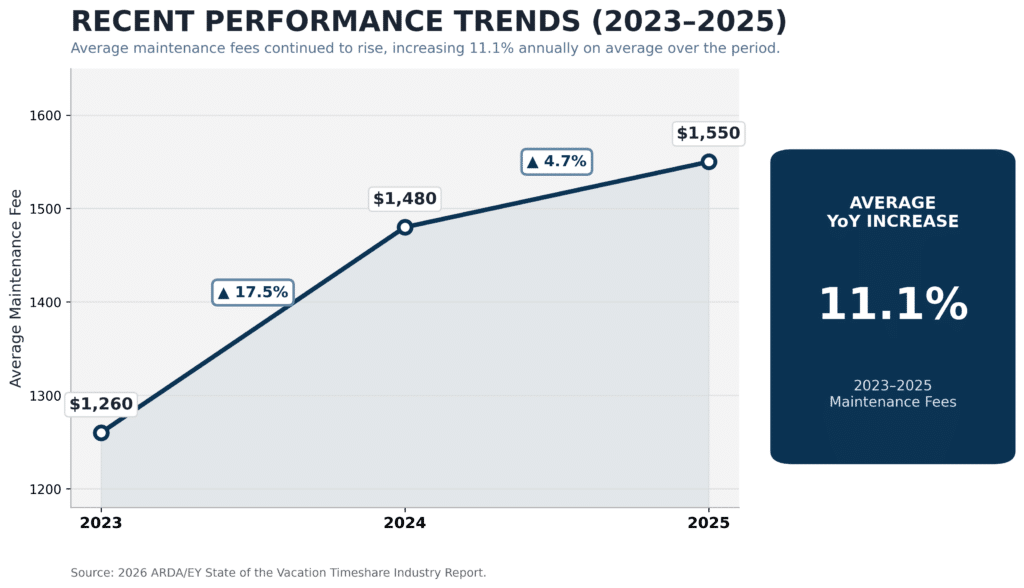
According to the 2026 State of the Vacation Timeshare Industry study prepared by Ernst & Young LLP for ARDA, the average maintenance fee reached approximately $1,550 per weekly interval equivalent in 2025. The study also reported that average maintenance fees increased at an average annual rate of roughly 11 percent during the previous three years.
That doesn’t mean every resort increased by exactly that amount.
Some increased less.
Others increased more.
The important takeaway is that the broader trend has been upward.
For owners living on fixed incomes, those increases often become one of the primary reasons they begin researching how to get out of a timeshare.
Consumer Tip
Don’t evaluate your ownership based only on this year’s maintenance fee.
Look at what you’ve paid over the past ten years and estimate what you may pay over the next ten if current trends continue.
That exercise often provides a clearer picture of the long-term financial commitment.
Are Special Assessments Changing the Conversation?
Short answer: For many owners, yes. Special assessments can add substantial unexpected costs on top of annual maintenance fees, making long-term ownership more difficult to justify.
Many owners budget for their annual maintenance fees.
Very few budget for an unexpected assessment.
Special assessments may be used to fund projects such as major building repairs, storm damage, infrastructure improvements, insurance increases, or deferred maintenance.
While these assessments vary by resort and are not universal, they can significantly increase the total cost of ownership in a single year.
We’ve spoken with owners who had no intention of pursuing a timeshare exit until an unexpected assessment arrived.
That assessment didn’t create the frustration.
It simply accelerated a decision they had already been considering.
Reality Check
Maintenance fees are only one part of the ownership equation.
When evaluating whether to keep or exit a timeshare, consider the full cost of ownership, including maintenance fees, assessments, travel expenses, exchange fees, reservation costs, and how often you realistically use the property today—not how often you hoped to use it years ago.
Is Selling a Timeshare Still Realistic?
Short answer: For a small percentage of owners, yes. For most owners, however, selling a timeshare on the resale market proves far more difficult than expected because supply greatly exceeds demand. Understanding that reality early can save years of frustration and unnecessary expense.
If there’s one assumption that catches owners off guard, it’s this:
“I paid more than $20,000 for my timeshare. Someone should be willing to buy it.”
It’s an understandable way to think.
After all, most major purchases retain at least some market value. Cars depreciate, but they can usually be sold. Homes fluctuate in value, but there is an active marketplace. Even boats, motorcycles, and recreational vehicles have established resale channels.
Timeshares are different.
In many cases, the challenge isn’t that the ownership has no value to the current owner. It’s that there are significantly more people trying to sell than there are people looking to buy.
That imbalance has shaped today’s resale market.
Why Is the Timeshare Resale Market So Difficult?
Short answer: The resale market is challenging because supply greatly exceeds demand. Millions of owners already hold timeshares, while relatively few consumers actively search to purchase one on the secondary market.
According to ARDA, more than 10 million U.S. households own some form of timeshare or vacation ownership interest.
Now compare that with consumer demand.
Monthly online searches according to Google’s keyword planner for phrases such as “buy timeshare” and “buy timeshare resale” represent only 0.0001% of the existing ownership base.
2026 Google Serach Volume Data
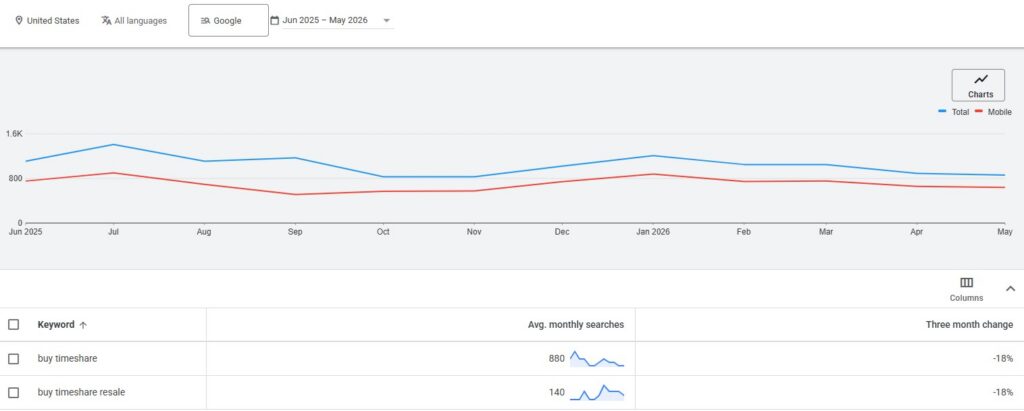
The gap tells an important story.
Even if every person searching for a resale completed a purchase, there would still be far more owners looking to sell than buyers entering the market.
That doesn’t mean resale is impossible.
It means expectations should be realistic.
Industry Insight
One of the biggest misconceptions surrounding timeshare resale vs exit company discussions is the belief that every ownership has the same resale potential.
It doesn’t.
Brand recognition, season, location, point ownership level, reservation flexibility, ownership type, loan status, and current market demand can all influence whether an ownership is likely to attract a buyer.
That’s why one owner may successfully sell while another receives little or no interest despite listing the ownership for years.
What Do Timeshare Resale Companies Actually Do?
Short answer: Most resale companies provide advertising or listing services rather than guaranteeing the sale of a timeshare. Before hiring one, it’s important to understand exactly what service is being purchased.
This distinction is grossly overlooked.
When many owners hear the phrase “timeshare resale company,” they naturally assume the company will sell their ownership.
In reality, many companies provide something very different.
Their agreement may focus on marketing the ownership by placing advertisements on websites, listing platforms, or other promotional channels.
That doesn’t necessarily mean the company is acting as a licensed real estate broker. Nor does it guarantee that a buyer exists.
Advertising and selling are two different services.
Understanding that difference before signing an agreement is essential.
Consumer Tip
Before hiring any resale company, ask one simple question:
“Am I paying you to advertise my timeshare, or are you representing me in an actual sale?”
Then ask a second question:
“If my timeshare doesn’t sell, what exactly have I purchased?”
The answers should be clearly reflected in the written agreement—not just discussed during a sales conversation.
Why Do Some Owners Spend Years Trying to Sell?
Short answer: Many owners continue renewing resale listings because they hope a buyer will eventually appear. During that time, however, maintenance fees and other ownership costs usually continue.
Imagine this scenario.
A couple pays $1,500 to advertise their ownership for a period of time.
The listing remains active.
Months pass.
Then a year.
No buyer appears.
Rather than changing strategies, they decide to keep waiting.
Meanwhile, annual maintenance fees continue arriving.
If maintenance fees average approximately $1,550 per year and increase at an average annual rate similar to recent industry trends, the cost of waiting can become significant.
Example Cost of Waiting
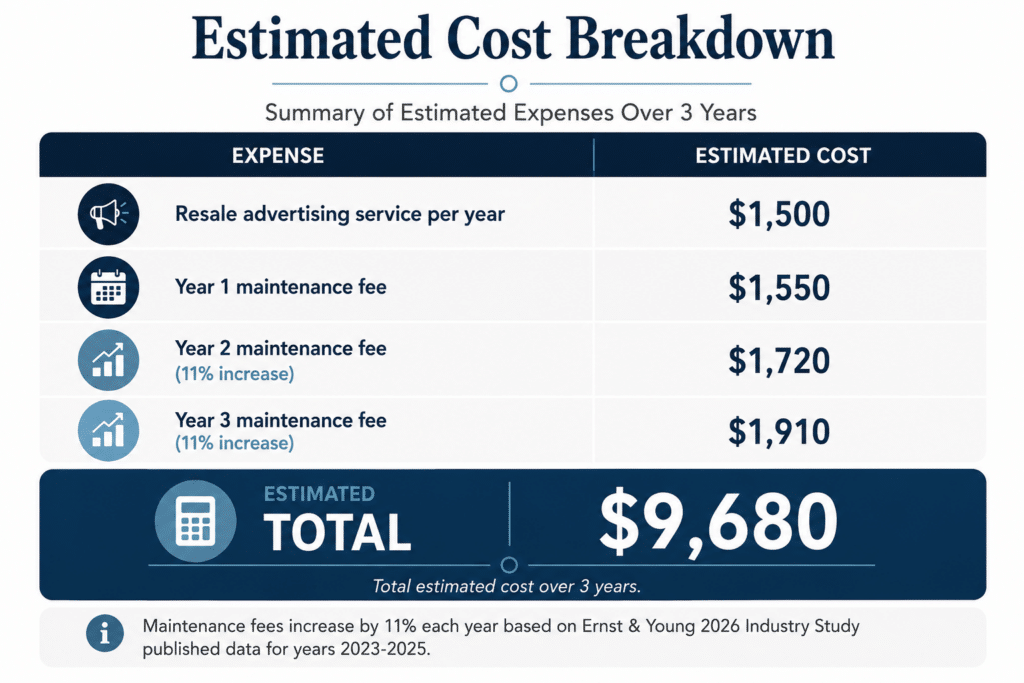
This example isn’t intended to predict every owner’s experience.
Some ownerships sell more quickly.
Others may never receive an offer.
The point is simpler.
Every additional year of ownership has a cost.
When evaluating a timeshare exit strategy, it’s important to compare not only the upfront fee for a service but also the financial impact of continuing ownership while waiting for a particular approach to work.
Reality Check
Price alone rarely tells the whole story.
A service with a lower upfront cost may ultimately become more expensive if it delays an outcome while maintenance fees continue increasing.
That’s one reason experienced professionals often evaluate the total cost of ownership, not just the price of the service itself.
Does That Mean Owners Should Never Try to Sell?
Short answer: Not necessarily. Some ownerships retain stronger resale demand than others. The key is determining whether resale is realistic before investing time and money pursuing that option.
Resale may still make sense if:
- Your ownership has demonstrated resale demand.
- Comparable ownerships have sold recently.
- A buyer already exists.
- A licensed broker familiar with your market believes the ownership is marketable.
- Your expectations align with current market conditions.
However, if resale demand appears extremely limited, it may be worth comparing other types of timeshare exit services before committing additional time or money to advertising.
The goal isn’t to discourage resale.
It’s to help owners choose the approach that best matches today’s market rather than yesterday’s expectations.
If I Were Helping My Parents…
I wouldn’t begin by asking which resale company had the most advertisements or the lowest fee.
I’d begin by asking a more important question:
“Is this ownership actually a realistic resale candidate?”
If the honest answer is “probably not,” I’d rather know that before spending another dollar.
Sometimes the most valuable advice isn’t hearing that an option exists.
It’s understanding whether that option makes sense for your particular ownership.
That simple shift in perspective can prevent years of frustration and help owners focus on solutions that better match their circumstances.
What Are the Different Types of Timeshare Exit Services?
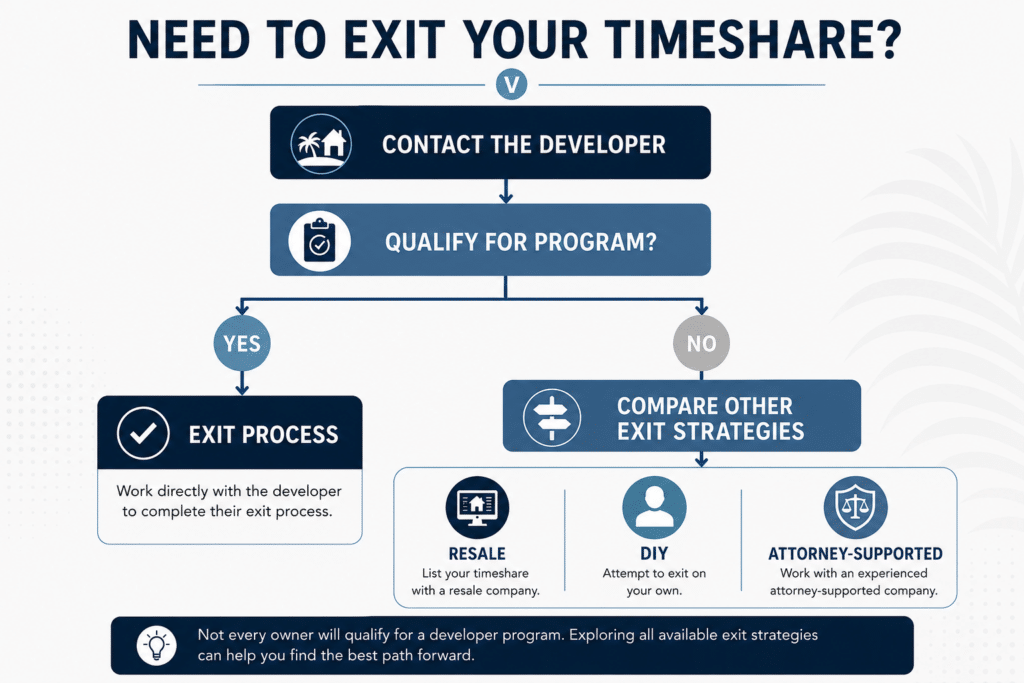
Short answer: Most owners will encounter four primary categories of types of timeshare exit services: developer exit programs, resale or listing companies, DIY exit advocates, and attorney-supported timeshare exit providers. Each serves a different purpose, and the right choice depends on your ownership, financial circumstances, and long-term goals.
One of the biggest mistakes owners make is comparing companies before they compare strategies.
That’s understandable.
When you’re ready to leave your timeshare, it’s natural to search for the “best company.”
However, experienced professionals usually begin somewhere else.
They start by asking:
“What strategy actually fits this ownership?”
That’s an important distinction.
Two companies may provide excellent service while offering completely different solutions. Likewise, one approach may work well for a particular owner while being completely inappropriate for another.
Before evaluating providers, it’s worth understanding the different categories of services available today.
Comparison at a Glance
| Exit Option | Primary Purpose | Best Fit | Typical Cost Range* | Legal Representation |
|---|---|---|---|---|
| Contact the Developer | Request a voluntary surrender or deed-back, if available | Owners who may qualify under current developer policies | $500-$2,000 | No |
| Resale or Listing Company | Advertise or market the ownership for sale | Ownerships with realistic resale demand | $500–$3,000 | No |
| DIY Exit Advocate | Educate and coach owners through the process | Owners comfortable managing their own communications with resort and affiliates | $3,000-$,6000 | No |
| Attorney-Supported Timeshare Exit | Provide tailored exit strategies and retained legal representation where appropriate | White glove service for owners wanting more individualized support | $2,000+, depending on circumstances | Yes |
*Costs vary based on ownership type, number of contracts, developer, and the services provided.
Why Isn't There One Best Timeshare Exit Strategy?
Short answer: Because no two ownerships and owner circumstances may be exactly alike. The most effective timeshare exit strategy depends on factors such as the developer, contract language, loan status, maintenance obligations, ownership structure, and the owner’s personal circumstances.
Imagine two owners.
Both purchased from the same developer.
Both own similar vacation interests.
At first glance, their situations appear identical.
Then you learn one owner purchased fifteen years ago, while the other purchased last year.
One still has financing.
The other owns free and clear.
One inherited the ownership.
The other purchased directly from the developer.
One has documented medical hardship.
The other simply no longer travels.
Those details matter.
What appears to be the same problem often requires very different solutions.
That’s why experienced professionals spend time understanding the ownership before recommending a path forward.
Industry Insight
One lesson continues to surface.
Owners often ask,
“Which exit company should I hire?”
A more productive question is,
“Which type of service best matches my situation?”
Once you understand the appropriate category of service, comparing individual providers becomes much easier.
Should You Contact Your Resort First?
Short answer: In many cases, yes. Contacting the developer directly is often a reasonable first step because some resorts offer surrender, deed-back, or other voluntary exit programs for qualifying owners. Eligibility requirements vary widely, and not every owner or ownership qualifies.
Before hiring anyone, it’s worth asking the resort a few straightforward questions.
- Do you offer a voluntary surrender program?
- Are there eligibility requirements?
- Does my loan need to be paid in full?
- Are maintenance fees required to be current?
- What documentation is needed?
- Is there a waiting period?
Some developers have established exit pathways.
Others evaluate requests individually.
Some may not currently offer voluntary programs at all.
The important point is this:
You won’t know until you ask.
If the resort cannot assist, delays your request indefinitely, or determines that your ownership does not qualify, that’s often when owners begin evaluating other types of timeshare exit services.
Consumer Tip
If you contact your resort, keep records of every conversation.
Save emails.
Write down dates.
Record the name of the representative.
Ask for written confirmation whenever possible.
Good documentation can be valuable later, regardless of which path you ultimately choose.
How Does a Developer Exit Program Compare to Other Options?
Developer programs can be an excellent solution when an owner qualifies.
However, eligibility often depends on factors such as:
- Loan status
- Maintenance fee status
- Ownership type
- Resort policies
- Program availability
- Financial hardship or other qualifying circumstances
Because those requirements differ from one developer to another, owners should avoid assuming another person’s experience will automatically apply to their own.
A friend may have received a deed-back offer.
That doesn’t necessarily mean every owner at the same resort will receive the same option.
Policies change.
Programs evolve.
Individual circumstances matter.
Reality Check
A developer declining an exit request does not automatically mean an owner has reached the end of the road.
It simply means one particular pathway may not currently be available.
Understanding what other options exist is often the next logical step—not the first.
What Is a DIY Timeshare Exit Advocate?
Short answer: A DIY timeshare exit advocate typically provides education, coaching, templates, or guidance while the owner remains responsible for communicating directly with the resort or developer. This approach may appeal to owners who are comfortable managing the process themselves, but it also requires time, organization, and an understanding of the potential risks.
Many owners begin with the do-it-yourself approach.
At first glance, it makes sense.
If you’re capable of managing your own finances, negotiating with service providers, or handling other personal matters, why not try handling your timeshare exit yourself?
For some owners, that approach may be entirely reasonable.
Especially if:
- The ownership is relatively straightforward.
- The developer offers an established surrender program.
- The owner is comfortable keeping detailed records.
- There are no unusual legal or financial complications.
In those situations, a DIY approach may be worth exploring.
However, it’s important to understand exactly what you’re taking on.
Unlike an attorney or a company providing retained legal representation, a DIY advocate generally educates or coaches the owner rather than acting on the owner’s behalf.
That distinction affects the level of responsibility the owner retains throughout the process. The advocate also almost never holds any credentials or certifications in this industry, and the coaching may be unreliable.
What Does a DIY Timeshare Exit Advocate Usually Provide?
Short answer: Most DIY advocates provide guidance rather than representation. Services may include suggested communication strategies, sample letters, document checklists, or general guidance designed to help owners navigate the process independently.
Depending on the provider, services may include:
- Exit planning guidance
- Suggested communication strategies
- Sample correspondence
- Document organization
- General information about common exit pathways
Those services can be valuable for owners who prefer to remain in control of every step.
However, they generally do not replace individualized legal advice or representation.
Owners should understand exactly what services are—and are not—included before deciding whether this approach fits their circumstances.
Industry Insight
One misconception worth addressing is the belief that every DIY provider offers the same level of support.
In reality, services vary significantly.
Some focus almost entirely on education.
Others provide ongoing coaching throughout the process.
Before hiring any provider, ask exactly what assistance is included, who will be working with you, do they hold any certifications or credentials to support their advice and what responsibilities remain yours.
What Are the Advantages of a DIY Timeshare Exit Approach?
Short answer: DIY approaches may appeal to owners who want to remain directly involved in every step of the process, understand their ownership well, and are comfortable communicating with the developer themselves.
Potential advantages may include:
- Greater personal control
- Direct communication with the resort
- Educational value
For some owners, those benefits outweigh the additional responsibility.
Others may decide they would rather have someone else help manage the process.
Neither decision is inherently right or wrong.
The key is understanding your own comfort level.
What Are the Potential Limitations of a DIY Timeshare Exit Approach?
Short answer: A DIY approach requires the owner to manage communications, documentation, and decision-making. Depending on the situation, some owners may find that process manageable, while others prefer additional professional support.
Potential considerations include:
- Communicating directly with the developer
- Organizing documentation
- Tracking deadlines
- Understanding contractual obligations
- Responding to changing circumstances
- Evaluating settlement or exit offers
For owners with straightforward situations, these responsibilities may be manageable.
For more complex circumstances, they may become increasingly challenging.
Consumer Tip
Ask yourself one honest question before choosing a DIY path.
“If the process becomes more complicated than expected, am I comfortable handling those conversations myself?”
There isn’t a right or wrong answer.
What Is an Attorney-Supported Timeshare Exit?
Short answer: An attorney-supported timeshare exit involves licensed legal professionals providing advice or representation in conjunction with the exit process. Depending on the engagement, that may include reviewing contracts, evaluating legal options, communicating with the developer, negotiating resolutions, and advising owners based on their individual circumstances.
This is where many owners become confused.
The phrase “attorney-supported” is used frequently throughout the industry.
Unfortunately, it doesn’t always mean the same thing.
That’s why owners should ask specific questions before assuming legal representation is included.
For example:
- Will I have retained legal representation?
- Will that attorney represent me personally?
- Will the attorney communicate directly with the developer?
- Are those services described in my written agreement?
Those questions matter because legal involvement can vary considerably from one provider to another.
Understanding the scope of representation before signing an agreement helps avoid misunderstandings later.
What Services May Be Included in an Attorney-Supported Approach?
While services differ among providers, attorney-supported engagements may include:
- Reviewing ownership documents
- Evaluating contractual obligations
- Assessing potential legal pathways
- Advising owners regarding available options
- Communicating with developers when appropriate
- Negotiating potential resolutions
- Assisting with documentation throughout the process
Again, every provider structures services differently.
Owners should review the engagement agreement carefully and ask questions about exactly what is included.
Industry Insight
One of the most important questions owners can ask is surprisingly simple:
“Who is actually doing the work?”
If legal representation is part of the service being discussed, ask whether that representation is direct, retained, and clearly described in the written agreement.
The answer should never depend solely on a verbal conversation.
DIY Timeshare Exit vs Attorney: Which Approach Is Right for You?
Short answer: The answer depends on your ownership, your comfort level, and your situation. Some owners successfully manage straightforward matters themselves, while others prefer attorney-supported guidance when legal, contractual, or financial issues become more involved.
Rather than asking which approach is “better,” consider which one better matches your circumstances.
Comparison
| Consideration | DIY Approach | Attorney-Supported Approach |
|---|---|---|
| Owner communicates directly | ✔ | Usually not, depending on representation |
| Educational guidance | ✔ | ✔ |
| Individual legal advice | No | Yes, where representation exists |
| Contract review | Limited or owner responsibility | Often included, depending on engagement |
| Negotiation assistance | Owner responsibility | Typically included |
| Documentation management | Owner | Provider-supported |
| Appropriate for complex situations | Sometimes | Often more appropriate |
Neither approach can guarantee a particular outcome or timeline.
The purpose of this comparison is to help owners understand the different levels of support available—not to suggest that one option fits every ownership.
If I Were Helping a Family Member…
I wouldn’t ask whether they could manage the process themselves.
I’d ask whether they wanted to.
Some people are comfortable researching contracts, organizing documents, and negotiating directly.
Others would rather spend that time enjoying retirement, caring for family, or focusing on their health.
Neither decision reflects ability.
It reflects priorities.
Choosing the right timeshare exit strategy isn’t about proving you can do everything yourself.
It’s about selecting the level of support that gives you the greatest confidence based on your circumstances.
How Much Does a Timeshare Exit Cost?
Short answer: The cost of a timeshare exit varies based on the type of service, the number of contracts involved, the developer, the ownership structure, the owner’s individual circumstances and exit method decided on. Industry pricing often ranges from approximately $2,000 to $4,000 on average, although some companies charge higher rates.
If you search online for how much does a timeshare exit cost, you’ll find a wide range of answers.
Some companies advertise prices that seem surprisingly low.
Others won’t discuss pricing until after a consultation.
That difference often leaves owners wondering whether they’re comparing similar services or completely different ones.
In many cases, it’s the latter.
One of the biggest misconceptions in this industry is that every timeshare exit service performs the same work.
They don’t.
A company advertising a resale listing isn’t providing the same service as an attorney-supported provider reviewing contracts and negotiating with a developer.
Likewise, a DIY coaching service differs significantly from a company providing hands-on case management with retained legal support.
Comparing those services based only on price is a little like comparing the cost of a home inspection with the cost of building a house.
Both relate to the same property.
They accomplish entirely different things.
Before comparing fees, make sure you’re comparing the services being provided.
That simple step can prevent expensive misunderstandings later.
What Factors Influence the Cost of a Timeshare Exit?
Short answer: Pricing usually depends on the owner’s circumstances and the scope of services being provided. Factors such as the number of contracts, ownership type, developer, loan status, and selected timeshare exit strategy all influence the total cost.
While every provider structures pricing differently, common considerations include:
- The number of timeshare contracts
- Whether the ownership is deeded, points-based, or right-to-use
- The developer or resort
- Whether financing remains outstanding
- The type of timeshare exit strategy being pursued
- Whether retained legal representation is included
- The owner’s circumstances
Because no two ownerships are exactly alike, reputable providers often review an owner’s situation before recommending a service or discussing pricing.
That isn’t necessarily a sales tactic.
It’s often the only practical way to determine what type of assistance may be appropriate, which determines the potential total out of pocket cost an owner may pay.
Why Isn't the Lowest Price Always the Best Value?
Short answer: A lower fee doesn’t always mean a lower overall cost. The true financial impact of any timeshare exit strategy should include both the service fee, potential settlement fees, potential ancillary exit costs, and the ongoing cost of ownership if the strategy doesn’t produce the desired outcome.
This is one of the most important ideas in this guide.
Imagine two owners.
The first spends $1,500 on a resale advertising service.
Three years later, the ownership still hasn’t sold.
During those three years, maintenance fees continued increasing.
The second owner hires an attorney-supported provider for a higher upfront fee.
Several months later, the owner receives a negotiated release that requires one final payment to complete the exit.
Which option was less expensive?
The answer depends on more than the initial invoice.
It depends on the total cost of ownership while pursuing each strategy.
Example: Comparing Total Out-of-Pocket Cost
The following example is illustrative and is not intended to predict every owner’s experience.
Actual costs, timelines, and outcomes vary.
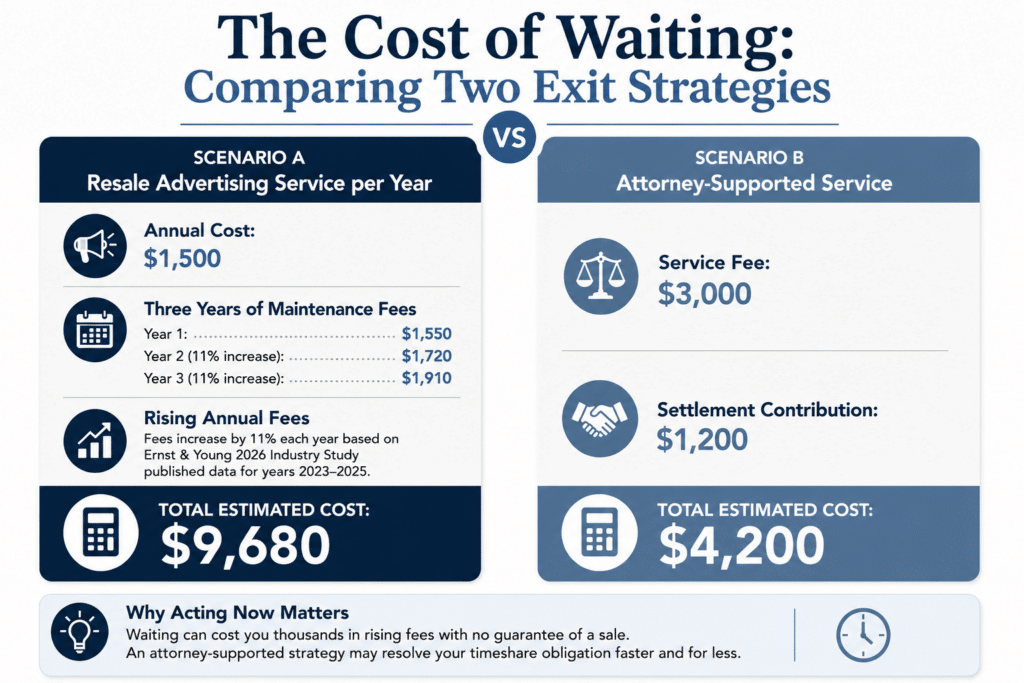
*Example assumes three years of ownership after hiring a resale company with maintenance fees increasing by approximately 11% annually based on recent industry averages reported by the 2026 Ernst & Young study. The attorney-supported example assumes a negotiated release approximately four months into the process. These examples are illustrative only and should not be interpreted as typical or guaranteed outcomes.
Industry Insight
Owners naturally focus on the price they’re about to pay.
Experienced professionals often focus on the total cost the owner may potentially incur.
Those are two very different calculations.
One looks at today’s expense.
The other looks at tomorrow’s financial obligation.
Considering both provides a more complete picture when evaluating a timeshare exit strategy.
What Questions Should You Ask Before Comparing Prices?
Short answer: Before comparing fees, understand exactly what services are included, whether pricing is transparent, and whether every important promise appears in the written agreement.
Here are a few questions worth asking any provider:
- What services are included in the quoted fee?
- Is the fee a one-time payment or can additional charges arise later?
- What responsibilities remain mine during the process?
- Are all verbal promises reflected in the written agreement?
- If legal representation is discussed, how is that described in the contract?
- Who will actually be working on my file?
- What happens if my circumstances change during the process?
The answers to these questions often reveal more about the value of a service than the quoted price alone.
Consumer Tip
Whenever someone promises something verbally, politely ask one follow-up question:
“Can you show me where that appears in the written agreement?”
Contracts—not conversations—define the relationship between a company and its client.
Review them carefully before making any decision.
If I Were Helping a Friend…
I wouldn’t encourage them to hire the least expensive company.
I’d encourage them to understand exactly what they were paying for.
Price matters.
Transparency matters more.
A clear agreement, realistic expectations, documented experience, and a service that matches the owner’s situation often provide far greater value than simply choosing the lowest number on a price sheet.
Sometimes the least expensive option becomes the most expensive decision if it delays a successful outcome while ownership costs continue accumulating.
That’s why evaluating a timeshare exit strategy should involve more than comparing fees.
It should involve understanding the total financial picture.
Reality Check When Price Shopping Timeshare Exit Companies
Choosing a timeshare exit strategy based only on the upfront fee can be misleading. A lower initial price may result in a higher overall cost if ownership expenses continue for years. Looking at both the service fee and the ongoing cost of ownership often provides a more meaningful comparison.
How Can You Verify Whether a Timeshare Exit Company Is Credible?
Short answer: Before hiring any timeshare exit company, look beyond advertising. Independent media coverage, financial education references, community organizations, customer reviews, longevity, and written agreements often provide a more complete picture than marketing claims alone.
One of the biggest challenges owners face isn’t finding a company.
It’s deciding which information to trust.
Almost every company says they’re “the best”.
Almost every website claims success.
Many advertise guarantees, proprietary strategies, or exclusive relationships.
Rather than relying solely on advertising, consider looking for independent signals that help validate a company’s reputation and operating history.
While no single factor should determine your decision, reviewing several sources together can provide a much clearer picture.
1. Has the Company Been Featured by Independent Media?
Independent interviews don’t necessarily endorse a company.
However, they can demonstrate that outside organizations considered the company knowledgeable enough to discuss industry topics publicly.
Examples may include:
- Television interviews
- Consumer education programs
- Podcasts
- Investigative features
- Industry discussions
For example, Vacation Ownership Consultants (VOC) has participated in several educational media appearances discussing topics such as how to get out of a timeshare, why resale often proves difficult for owners, and common exit misconceptions.
Examples include:
- Better Business Bureau’s Joe Knows Better podcast discussing why many owners struggle with resale.
- ABC15 Arizona’s Sonoran Living educational segment covering timeshare exit options.
Media appearances should not be viewed as endorsements.
Instead, they can serve as one piece of a broader due diligence process.
2. Do Independent Financial Education Websites Reference the Company?
Financial education websites typically evaluate companies differently than marketing websites.
Rather than relying on advertising language, they often review business history, customer reputation, transparency, and publicly available information.
Examples referencing Vacation Ownership Consultants include:
- Well Kept Wallet
- BestCompany
- Credit Absolute
Again, no single review should determine your decision.
Looking for consistency across multiple independent publications is generally more helpful than relying on one source alone.
3. Is the Company Active in Its Community?
Long-term companies often participate in professional organizations and local business communities.
Examples include:
- Scottsdale Area Chamber of Commerce
- Spotlight Senior Services
- Community education podcasts such as Finding AZ
Community involvement doesn’t guarantee quality.
However, it may demonstrate long-term investment in the business beyond online advertising.
4. What Do Third-Party Reviews Look Like?
Reviews should always be read carefully.
No company receives every review under identical circumstances.
Instead of focusing only on the overall rating, consider patterns.
Ask questions like:
- Do reviewers mention communication?
- Do they discuss transparency?
- Are expectations explained clearly?
- Does the company respond professionally?
- Are reviews spread over many years?
For example, at the time of writing, Vacation Ownership Consultants maintains:
| Platform | Public Rating* |
|---|---|
| BBB | Accredited Business, A+ Rating, 4.96 Stars |
| 5.0 Stars | |
| Trustpilot | 4.9 Stars |
| 100% Recommendation | |
| Yelp | 4.6 Stars |
*Ratings change over time and should always be verified directly on each platform.
5. Has Anyone Else Trusted the Company's Educational Resources?
One signal many consumers overlook is whether other professionals reference a company’s educational content.
For example, a published guide from Ferguson & Ferguson, Attorneys at Law links to Vacation Ownership Consultants’ website as an educational resource discussing how to get out of a timeshare. Similarly, consumer financial education website Debt.org references Vacation Ownership Consultants’ educational content in its article explaining how heirs can refuse to inherit a timeshare, citing VOC as a resource for readers seeking additional information on the topic.
That doesn’t necessarily mean every reader should hire VOC.
However, when independent law firms, financial education websites, and other professional organizations choose to reference a company’s educational resources, it can indicate they found the information sufficiently accurate, relevant, or helpful to include as a resource for their own readers.
Industry Insight
One of the strongest indicators of credibility isn’t a television appearance, an award, or even a five-star review.
It’s consistency.
Does the company tell the same story everywhere?
Do its written agreements reflect its verbal explanations?
Has it operated long enough to build a documented history?
Can you independently verify what it says?
Those questions often reveal far more than any advertisement ever could.
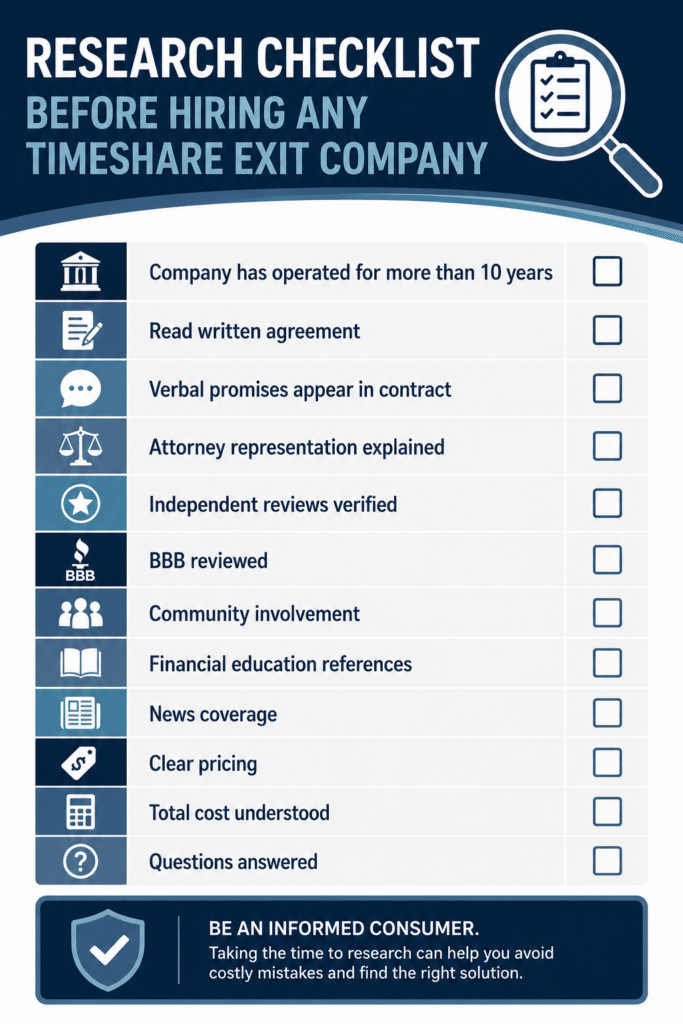
Research Checklist Before Hiring Any Timeshare Exit Company